News 8, April 8, 2017
NEW HAVEN, Conn. (WTNH) – April is National Alcohol Awareness Month and with events like spring break and prom happening this time of year Monique Price-Taylor from the Governor’s Prevention Partnership stopped by our studio to remind all Connecticut parents that teens and alcohol don’t mix.
What is the Governor’s Prevention Partnership?
The Governor’s Prevention Partnership is a statewide prevention agency that works with organizations throughout Connecticut to educate youth on substance abuse and underage drinking prevention, mentoring and anti-bullying initiatives
What is the Peer-to-Peer Prevention Initiatives Program?
This is a program that strives to teach young people how to make healthy decisions around alcohol and substance abuse through what is called the E3 program…Encourage, Empower, Engage. See the video and read more.
View additional resources for parents to speak with youth about the dangers of underage drinking.
Monday, April 10, 2017


Tuesday, April 4, 2017
April 3rd – April 7th is National Youth Violence Prevention Week
According to the Juvenile Offenders and Victims: 2014 National Report, 61% of youth under the age of 17 were exposed to violence in the past year, either as a witness or a victim. Nearly 50% were victims of assault in the past year, more than 20% reported being bullied at school within their lifetime, and 12% of girls reported sexual victimization at some point in their lifetime.
Given these staggering statistics, National Youth Violence Prevention Week calls on parents, teachers, counselors, and teens to work together and help youth thrive without the threat or fear of violence. Remember, no effort is too small for making a positive change. Start today:
Given these staggering statistics, National Youth Violence Prevention Week calls on parents, teachers, counselors, and teens to work together and help youth thrive without the threat or fear of violence. Remember, no effort is too small for making a positive change. Start today:
- Bystanders, speak up. Learn the signs of bullying, and talk to a principal, teacher or school counselor if someone you know is being bullied at school. They can best handle the situation and report incidents to the proper authorities.
- If you’ve been a victim of physical or sexual violence, talk to an adult or call one of the toll-free numbers listed below. Often, you can make these reports anonymously, without having to identify yourself.
- Engage with your community by downloading the Strategic Plan Development Toolkit, or use the Map My Community tool to find local violence prevention organizations that you can support.
- Use the National Youth Violence Prevention Week resources to help prevent crime, manage conflicts, and enhance service projects in your community.
- Talk to teens about healthy and unhealthy relationships with friends, family members, and romantic partners to help them identify signs of abuse.
- National Suicide Prevention Lifeline: 1-800-273-TALK (8255) [24/7 hotline] or 1-888-628-9454 (Spanish)
- National Domestic Violence Hotline: 1-800-799-7233
- National Teen Dating Abuse Helpline: 1-866-331-9474
- National Sexual Assault Hotline: 1-800-656-HOPE (4673)
- National Child Abuse Hotline: 1-800-4-A-CHILD (22-4453)
- National Coalition of Anti-Violence Programs: 1-212-714-1141
Thursday, July 21, 2016
The ABCs of BAC
by Jacqueline Longo, July 21, 2016
Program Coordinator, Youth Leadership
The Governor's Prevention Partnership
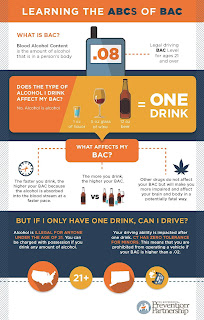
Ever hear the acronym BAC? Do you know what it means? Take a
look at the following infographic and learn all about the meaning of BAC and
how it can impact you.

Tuesday, July 19, 2016
Alcohol and Your Developing Brain
by Jacqueline Longo, July 19, 2016
Program Coordinator, Youth Leadership
The Governor's Prevention Partnership
View additional resources for parents to speak with youth about the dangers of underage drinking.
Thursday, July 14, 2016
Prescription Drug Abuse: The New Epidemic
by Jacqueline Longo, July 14, 2016

Program Coordinator, Youth Leadership
The Governor's Prevention Partnership
Using a prescription medication when it is not prescribed to you is just as dangerous as using an illegal drug. Yet, in 2015, 12% of high school teens report to abusing a prescription drug to get high. The perception of harm of prescription drug abuse continues to decrease in the state of Connecticut with the number of youth who use, continuing to increase. Start talking to the teen in your life and learn more about prescription drug abuse and the impact it can have on young people with the following infographic.

Tuesday, July 12, 2016
Marijuana: The Reality
by Jacqueline Longo, July 12, 2016
Program Coordinator, Youth Leadership
The Governor's Prevention Partnership
Marijuana use continues as the number 2 substance abused by Connecticut teens with 20% in 2015 reporting to smoking marijuana in the last 30 days. Marijuana can have a significant impact on the health of a young person and reports show that it is addictive!
Learn the truth about the physical, mental, and social consequences of smoking marijuana in the following infographic. Remember: Not everyone is doing it!

View additional resources for parents to speak with youth about the dangers of substance abuse.
Thursday, July 7, 2016
Marijuana and Addiction
by Jacqueline Longo, July 7, 2016
Program Coordinator, Youth Leadership
The Governor's Prevention Partnership
We hear quite often from youth and parents that they believe marijuana is not addictive. This is a misconception as research has proven that marijuana is a highly addictive drug with the chances of addiction increasing with earlier use. The National Institute of Drug Abuse states that individuals who use marijuana before the age of 18 are 4-7 times more likely to become addicted as they enter adulthood. “It is estimated that about 1 in 6 people who start using as a teen…become addicted to marijuana.” Since the brain is not fully developed until the mid-20s, teens have a higher risk of addiction with marijuana affecting memory, emotion control, coordination, and other necessary brain functions. With marijuana being the most commonly abused illicit drug in the United States and with the high possibility of addiction, it is important to educate our young people on the risks of marijuana use.
Program Coordinator, Youth Leadership
The Governor's Prevention Partnership
We hear quite often from youth and parents that they believe marijuana is not addictive. This is a misconception as research has proven that marijuana is a highly addictive drug with the chances of addiction increasing with earlier use. The National Institute of Drug Abuse states that individuals who use marijuana before the age of 18 are 4-7 times more likely to become addicted as they enter adulthood. “It is estimated that about 1 in 6 people who start using as a teen…become addicted to marijuana.” Since the brain is not fully developed until the mid-20s, teens have a higher risk of addiction with marijuana affecting memory, emotion control, coordination, and other necessary brain functions. With marijuana being the most commonly abused illicit drug in the United States and with the high possibility of addiction, it is important to educate our young people on the risks of marijuana use.
View
additional resources for parents to speak with youth about the dangers of
substance abuse.
Parenting for Prevention Tips:
- Start talking: Kids who learn about the risks of drugs at home are up to 50% less likely to use.
- Keep the conversation going: You may think your child isn’t listening, but they hear you!
- Set firm limits and have a clear no use policy: Let your child know that you disapprove of any drug or alcohol use.
Wednesday, July 6, 2016
The Truth behind the New Haven Public Health Emergency issued on June 24, 2016
by Jacqueline Longo, July 6, 2016
Program Coordinator, Youth Leadership
The Governor's Prevention Partnership
Program Coordinator, Youth Leadership
The Governor's Prevention Partnership
On June 24, 2016, New Haven declared a public health
emergency after a tainted batch of drugs caused two deaths and 20 drug
overdoses. Officials released that the victims thought they were buying
cocaine, when instead officials believe they bought a synthetic opiate called
Fentanyl. The drug in question is still being investigated but a warning has
been issued in the New Haven community as fentanyl is an extremely potent
opioid that is up to a 100 times stronger than heroin. Officer David Hartman,
public information officer for New Haven Police, warns all heroin users as
Fentanyl is the cause of many overdoses across the state.
Connecticut youth continue to be impacted by the level of
drug use in the state. According to news reports, five of the overdose victims
were found in the parking lot next to Hillhouse High School in New Haven. In
the most recent Connecticut Youth Risk Behavior Survey, 12% of high school
students report to misusing prescription drugs and 2.2% report to using heroin.
The perception of harm of misusing prescription drugs continues to decrease as
many youth believe they are safer and will not cause harm. The Center for Disease
Control states that abusing prescription opioids is the strongest risk factor
for a heroin addiction. With the increase in high school aged youth abusing
prescription medications, the number of older heroin users will increase. It is
important to remind our youth that using a prescription medication when it is
not prescribed to you is just as dangerous as using an illegal drug.
View
additional resources for parents to speak with youth about the dangers of
substance abuse and to learn more about the opioid epidemic that is hitting the
United States.
Thursday, June 30, 2016
Risk of Mixing
by Jacqueline Longo, June 30, 2016
Program Coordinator, Youth Leadership
The Governor's Prevention Partnership

Program Coordinator, Youth Leadership
The Governor's Prevention Partnership
Energy drinks
contain large amounts of caffeine and sugar and are the drink of choice among
many young people. A common behavior is mixing alcohol with energy drinks but
this comes with many negative side effects as alcohol and energy drinks don’t
mix. Learn about the risks and consequences associated with mixing these two
liquids in the following infographic.

Tuesday, June 28, 2016
Alcohol and Your Teen
by Jacqueline Longo, June 28, 2016
Program Coordinator, Youth Leadership
The Governor's Prevention Partnership

View additional
resources for parents to speak with youth about the dangers of
substance abuse.
Program Coordinator, Youth Leadership
The Governor's Prevention Partnership
Alcohol is the
number one substance abused by Connecticut youth with over 30% of high school
students in 2015 reporting to having a drink in the last 30 days. With
July 4th barbecues approaching, it is important to talk to your youth
about the negative consequences of alcohol. Learn the truths about underage
drinking and the physical, mental, and social consequences in the following
infographic. Remember: Not everyone is doing it!

Friday, June 24, 2016
Public health emergency declared in New Haven after 2 deadly heroin overdoses on June 23, 2016
by Jacqueline Longo, June 24, 2016
Program Coordinator, Youth Leadership
The Governor's Prevention Partnership
Program Coordinator, Youth Leadership
The Governor's Prevention Partnership
The heroin epidemic in Connecticut is making headlines again
today, with more than 15 overdoses, including 2 deaths, reported in New Haven
on June 23rd. Officials are
saying that the number of overdoses may rise, as there appears to be a tainted
batch on the streets. Due to the
severity of the situation, city leaders have issued a public health
warning. Additional information on this emerging
story may be found here.
With the number of opioid-related accidental drug intoxication
deaths continuing to rise, prevention of alcohol and other drug use in youth
becomes especially important. According to the Office of National Drug Control
Policy, four out of five heroin users start by developing an addiction to
prescription painkillers. In 2015, the
number of high school students who reported misusing prescription medications
increased to 12 percent. The Center for Disease Control states that abusing
prescription opioids is the strongest risk factor for a heroin addiction. It is
important to remind our youth that using a prescription medication when it is
not prescribed to you is just as dangerous as using an illegal drug.
Tips
Be aware of what is in your medicine cabinet, secure your
medications, and dispose of unused prescriptions at the many prescription
medication drop boxes in Connecticut. View here to find
a local collection box near you!
View
our Opioid Fact Sheet and continue to communicate with the young people in
your life. Kids who learn a lot about the risks of drugs at home are up to 50%
less likely to use drugs.
View
additional resources for parents to speak with youth about the dangers of
substance abuse.
Thursday, June 23, 2016
Marijuana and Addiction: the Truth Unfolds
by Jacqueline Longo, June 23, 2016
Program Coordinator, Youth Leadership
The Governor's Prevention Partnership
Program Coordinator, Youth Leadership
The Governor's Prevention Partnership
We
hear quite often from youth and parents that they believe marijuana is not
addictive. This is a misconception. Research has shown that marijuana is
a highly addictive drug. The earlier someone starts using, the greater
the chance of becoming addicted. The National Institute of Drug Abuse
states that individuals who use marijuana before the age of 18 are 4-7 times
more likely to become addicted as they enter adulthood. “It is estimated that
about 1 in 6 people who start using as a teen…become addicted to marijuana.”
Since the brain is not fully developed until the mid-20s, teens have a higher
risk of addiction. Further, marijuana use affects memory, emotion
control, coordination, and other important brain functions. With marijuana
being the most commonly abused illicit drug in the United States and with the
high possibility of addiction, it is important to educate young people on the
risks of marijuana use.
- Start talking: Kids who learn about the risks of drugs at home are up to 50% less likely to use.
- Keep the conversation going: You may think your child isn’t listening, but they hear you!
- Set firm limits and have a clear no use policy: Let your child know that you disapprove of any drug or alcohol use.
View additional resources for parents to speak with youth about the dangers of substance abuse.
Thursday, June 16, 2016
The Results are in: The 2015 Connecticut Youth Risk Behavior Survey is out for CT and the Rest of the Country.
by Jacqueline Longo, June 16, 2016
Program Coordinator, Youth Leadership
The Governor's Prevention Partnership
The data we have all been waiting for is here! DPH and the CDC have released the results of the 2015 CT Youth Risk Behavior Survey. The Youth Risk Behavior Survey covers six topics that address health behaviors among high school students. These topics include, injuries and violence, tobacco use, alcohol and other drug use, sexual behaviors, unhealthy dietary behaviors, and physical inactivity. The data is out for the Connecticut and the rest of the country. DPH has not yet released their report, which will provide a more in depth analysis but the Connecticut results shares some important trends in substance abuse and other risky behaviors.
View additional resources to speak with youth about the dangers of substance abuse and underage drinking.
Program Coordinator, Youth Leadership
The Governor's Prevention Partnership
The data we have all been waiting for is here! DPH and the CDC have released the results of the 2015 CT Youth Risk Behavior Survey. The Youth Risk Behavior Survey covers six topics that address health behaviors among high school students. These topics include, injuries and violence, tobacco use, alcohol and other drug use, sexual behaviors, unhealthy dietary behaviors, and physical inactivity. The data is out for the Connecticut and the rest of the country. DPH has not yet released their report, which will provide a more in depth analysis but the Connecticut results shares some important trends in substance abuse and other risky behaviors.
For more information about YRBS:
·
Phone: 1-800-CDC-INFO (1-800-232-4636)
·
Email: nccddashinfo@cdc.gov
View additional resources to speak with youth about the dangers of substance abuse and underage drinking.
Tuesday, June 14, 2016
CT STUDENT EARNS PRESTIGIOUS APPOINTMENT TO NATIONAL SADD BOARD
- Governor’s Prevention Partnership Announces Jozzlynn Lewis Chosen as 1 of 15 Nationwide -

(HARTFORD,
CT) – June
10, 2016 – While many Connecticut students will be honored with end-of
-year school awards, Putnam High School Junior Jozzlynn Lewis has
earned a coveted spot on a national teen board. Each year, Students Against Destructive Decisions or SADD, provides an opportunity for select students to join an exciting
advocacy-training program called SADD SPEAKs. SADD state coordinator for Connecticut,
the Governor’s Prevention Partnership, recently announced Lewis’ appointment at
the Governor’s Residence Reception on Tuesday, June 7th in Hartford.
“Jozzlynn was one of only 15 young people from across the country who
was chosen. It is quite an honor!” said Jill Spineti, President & CEO, The
Governor’s Prevention Partnership (The Partnership). “This is also significant
for The Partnership because this is the first time in ten years that we have
had a youth from Connecticut involved in a national SADD initiative.”
Lewis addressed the invited CEOs, Commissioners, and other
high level officials at Tuesday’s event hosted by Governor Malloy and the
Partnership’s Board of Directors. The Partnership also
shared its new strategic plan to the attendees, who generously support the
non-profit organization. The plan is focused on The Partnership’s mission to
equip and connect community groups, business leaders and families to prevent
substance abuse, underage drinking and violence among youth.
“While underage drinking has dropped 8.9 percent, that's not good
enough,” states Spineti. “More than 50 percent of Connecticut's youth continue
to deal with issues of drug use, family alcoholism, bullying and child abuse.
We partner with SADD and exemplary students such as Jozzlynn to help children avoid
all substances to ensure a healthier future.”
Lewis, 17, underwent
a competitive selection process which focused on her experience, leadership
qualities, public speaking ability, and other criteria. She was recognized as a
dynamic student leader who has also been
involved in her local substance abuse prevention coalition, Putnam PRIDE, for
many years, along with her mother, Cheryl Lewis. Her interest in SADD stems
from seeing alcohol and substance use in her own school.
“Sometimes kids come to
class under the influence,” explains Lewis. “This has a negative influence
on all of the students, not just the ones who use. I became involved in
SADD in order to make a difference and do my part to make things better.”
Lewis’
commitment and dedication certainly impressed the judging panel. “Jozzlynn is
deserving of this high honor. Her deep desire to empower her peers and change
her community will serve her well, as she works to implement policy change at
the local, state, and national level,” said Dawn Teixeira, SADD president and
chief executive officer. “Motivated young people are a true catalyst for social
change.”
“I am so very proud of Jozzlynn and her dedication to SADD, as well as
her commitment to wanting to make Putnam High School and our community a safer
place to learn and live,” adds Lisa Mooney, School Social Worker and SADD
Advisor at Putnam High School.
SADD SPEAKs (Students for Policy, Education, Advocacy, &
Knowledge) is an initiative of SADD National, funded by State Farm that focuses
on addressing an impaired driving issue. The participants will have a
positive and lasting effect on public policy, demonstrating the power of
America’s young people to speak persuasively on critically important issues.
They will be trained in coalition building, public speaking and advocacy skills.
This year’s SADD
SPEAKs delegates will develop an advocacy plan to address an impaired driving
issue (distracted, drowsy, drugged or underage drinking and driving). The group
will then lead the national organization’s efforts on Capitol Hill and before
their own state and local governments, as well
as mobilize thousands of SADD students across the country.
View additional resources to speak with youth about the dangers of underage drinking
Thursday, June 9, 2016
What’s in your Medicine Cabinet?
by Jacqueline Longo, June 9, 2016
Program Coordinator, Youth Leadership
The Governor's Prevention Partnership
Program Coordinator, Youth Leadership
The Governor's Prevention Partnership
Opioid abuse has taken the state by storm as the misusing of
prescription medications continues to increase in high school students and the
connection between prescription painkillers and heroin becomes clearer. The
2015 Connecticut Youth Risk Behavior Survey states that 12% of high school
students have misused prescription medications.
These teens report to getting these substances from friends, family, and
their medicine cabinets. These medications, when taken correctly, can be
helpful to the intended patient, but when misused, they are just as dangerous
as an illicit drug. The Center for Disease Control states that abusing prescription
opioids is the strongest risk factor for a heroin addiction. According to the
Office of National Drug Control Policy, four out of five heroin user’s start by
developing an addiction to prescription painkillers.
Be aware of what is in your medicine cabinet, secure your
medications, and dispose of unused prescriptions at the many prescription
medication drop boxes in Connecticut. View here to find
a local collection box near you!
View additional resources to speak with youth about the dangers of misusing prescription pills and substance abuse.
Tuesday, June 7, 2016
Fentanyl: Around the State and the County
by Jacqueline Longo, June 7, 2016
Program Coordinator, Youth Leadership
The Governor's Prevention Partnership
Program Coordinator, Youth Leadership
The Governor's Prevention Partnership
Fentanyl made headlines once again last week when it was
announced that it was an unintentional overdose of the power painkiller that
killed Prince. This story was a little
different in that in Prince’s case, it was fentanyl alone that caused his
death, rather than the more common situation of heroin laced with
fentanyl.
Fentanyl is an extremely strong synthetic opioid that is
used to treat high levels of pain, effecting the brain and body like other
prescription painkillers. It is stronger
than morphine and heroin and can cause dangerous side effects if taken without
instruction or if mixed with other substances.
In Connecticut, fentanyl has made an appearance in an increasing number
of drug overdoses in the last 3 years.
As in Prince’s case, it has caused overdoses all on its own in our
state. In 2015, there were 31 accidental drug intoxication deaths from fentanyl
as a standalone drug. This number has almost tripled since 2014 with 12
fentanyl overdoses that year and has increased 5 fold with 6 overdoses in
2013.
The use of fentanyl and other opioids, continue to rise in
Connecticut. When opioids are misused, these medications can be harmful and can
possibility lead to addiction and other illegal drug use. Using prescription
medications when they are not prescribed to you is just as dangerous as using
an illegal drug.
View
our Opioid Fact Sheet and continue to communicate with the youth in your
life. Kids who learn a lot about the risks of drugs at home are up to 50% less
likely to use drugs.
View additional resources to speak with youth about the dangers of substance abuse.
Thursday, June 2, 2016
Summertime Safety
by Jacqueline Longo, June 2, 2016
Program Coordinator, Youth Leadership
The Governor's Prevention Partnership
Program Coordinator, Youth Leadership
The Governor's Prevention Partnership
The school year
is winding down and young people are getting ready to relax and enjoy some
summer fun with their friends and families. At the same time, the summer
months bring great risks to our teenagers. Car crashes are the number one cause
of death in teenagers and the rates significantly increase in the summer
months. This is from impaired driving, distracted driving, and reckless
behavior.
Sometimes, too,
parents and adults let their guard down over the summer months due to parties,
vacations, and less hectic schedules which allows youth to have easier access
to alcohol and have a greater risk of participating in risky behavior. Use this
time to start talking with the teens in your life about impaired driving,
reckless behavior, and substance use. Use the resources below to find out more!
View additional resources to speak with youth about the dangers of underage drinking and substance abuse.
Tuesday, May 31, 2016
Teens and Alcohol Don’t Mix: Hear More from Fox61
Fox 61 News, May 25, 2016
"The spring celebration season is in full force with graduations, weddings and outside barbecues, however, the Governor’s Prevention Partnerships reminds all CT parents that teens and alcohol don’t mix! In fact, we're making it our mission to educate families and teens about underage drinking laws and health risks. Check out this short FOX61 interview to learn more!"
View additional resources to speak with youth about the dangers of underage drinking.
"The spring celebration season is in full force with graduations, weddings and outside barbecues, however, the Governor’s Prevention Partnerships reminds all CT parents that teens and alcohol don’t mix! In fact, we're making it our mission to educate families and teens about underage drinking laws and health risks. Check out this short FOX61 interview to learn more!"
View additional resources to speak with youth about the dangers of underage drinking.
Thursday, May 26, 2016
Positive School Climate
The Governor’s Prevention Partnership Positive School Climate Initiative is grounded in the understanding of what each individual child needs to be a successful learner. A positive learning environment, free from the threats of violence, bullying, alcohol or drug abuse, is proven to help a young person succeed against these odds. Today, the state requires that every school adopt a policy on bullying and designate an on-site staff person to the issue. Our job is to help.
View our 7 - Step Positive School Climate resource which highlights the need for staff awareness and buy-in, student empowerment and leadership skills, adult modeling, and relationship building. All are examples of necessary components of school climate which are key to reducing dropout rates and risky behaviors, and fostering youth development and academic achievement.
Upcoming Trainings:
Join us for our Bullying 101 webinar on June 28th from 12:00pm-1:00pm
View our 7 - Step Positive School Climate resource which highlights the need for staff awareness and buy-in, student empowerment and leadership skills, adult modeling, and relationship building. All are examples of necessary components of school climate which are key to reducing dropout rates and risky behaviors, and fostering youth development and academic achievement.
Upcoming Trainings:
Join us for our Bullying 101 webinar on June 28th from 12:00pm-1:00pm
Tuesday, May 24, 2016
Youth Bullying in Connecticut
Bullying is one of the most widespread and under reported problems within our schools and communities. Once dismissed as “kids being kids,” bullying is no longer viewed as harmless behavior that builds character. Bullying is now known to have long-term negative academic, emotional and social effects on targets, bullies and bystanders.
1 out of 5 students were bullied on school property in 2015
1 out of 7 students were electronically bullied in 2015
Learn the warning signs:
• Unexplained damage or loss of clothing and other personal items
• Evidence of physical abuse, such as bruises or scratches
• Loss of friends; changes in friends
• Reluctance to participate in activities with peers
• Loss of interest in favorite activities
• Unusually sad, moody, anxious, lonely, or depressed
• Problems with eating, sleeping, bed-wetting
• Decline in school achievement
• Headaches, stomachaches, other physical complaints
Upcoming Trainings:
Join us for our Bullying 101 webinar on June 28th from 12:00pm-1:00pm
Check back in on Thursday May 26th for more information on how to create a positive school climate within your community.
View additional resources for parents.
1 out of 5 students were bullied on school property in 2015
1 out of 7 students were electronically bullied in 2015
Learn the warning signs:
• Unexplained damage or loss of clothing and other personal items
• Evidence of physical abuse, such as bruises or scratches
• Loss of friends; changes in friends
• Reluctance to participate in activities with peers
• Loss of interest in favorite activities
• Unusually sad, moody, anxious, lonely, or depressed
• Problems with eating, sleeping, bed-wetting
• Decline in school achievement
• Headaches, stomachaches, other physical complaints
Upcoming Trainings:
Join us for our Bullying 101 webinar on June 28th from 12:00pm-1:00pm
Check back in on Thursday May 26th for more information on how to create a positive school climate within your community.
View additional resources for parents.
Subscribe to:
Posts (Atom)